
The supervisor has the brief before the shift. Plan on 10 to 15 minutes, and run it as long as you want. It covers more than safety, in plain language, so the crew stays with it. They answer two questions out loud. The supervisor signs the sheet.
- Open it in the browser, or hand out the printed PDF.
- Read what went wrong, then the control from that incident. Your qualified person decides what applies on your shift.
- Ask the two questions. The crew answers out loud, not with a nod.
- Hand out the attendance sheet. Each person prints a name and signs.
- The supervisor signs the sheet. Signing in the browser is coming soon. When the account is open, we will store the sign-off: name, crew, and date.
Plan on 10 to 15 minutes. More detail, not a rush. The incident is from your industry. There is a Spanish version of the same brief.
Want meetings longer than that? Email hello@dailyshiftbrief.com or contact us. We'll talk it through and build a program for it.
Optional add-on, free
Shift End Test: free, optional. A short test at the end of the week on everything the crew heard. The results show you who's tuned in and which topics didn't land, so you know what to revisit and how to put it differently next time. It runs on that crew's working days, so nobody has to come in on a day off to take it. Daily Shift Brief's topics and services do not in any way contribute to OSHA policy or compliance.
Any rotation
Four on four off, rotating twelves, straight days, any rotation. Each crew gets its briefings on the days it actually works. No extra days.
The brief sits next to the plant's own program. The supervisor still makes the call on that shift. It helps crews stay alert to what actually hurts people.
Print this page if you want the layout on letter paper. The menu stays off the paper.
Download the PDF Attendance sheet
Shift-Start Safety Briefing: Unguarded Conveyor Roller
A fingertip amputation at a motor vehicle parts plant in Alabama · Shift-start briefing · 10-15 minutes
Built from the OSHA public record. Review with your site's competent person before use. This briefing does not replace training required by specific OSHA standards. Employer name withheld. Incident facts are from the employer's report to OSHA.
What went wrong
The employer reported to OSHA that on February 6, 2025, at a motor vehicle parts plant in Alabama, an employee was troubleshooting a conveyor that was sticking. His glove was pulled into the conveyor roller. He suffered a fingertip amputation.
The employer reported to OSHA that the machine was not guarded at the time.
The control that would have stopped it
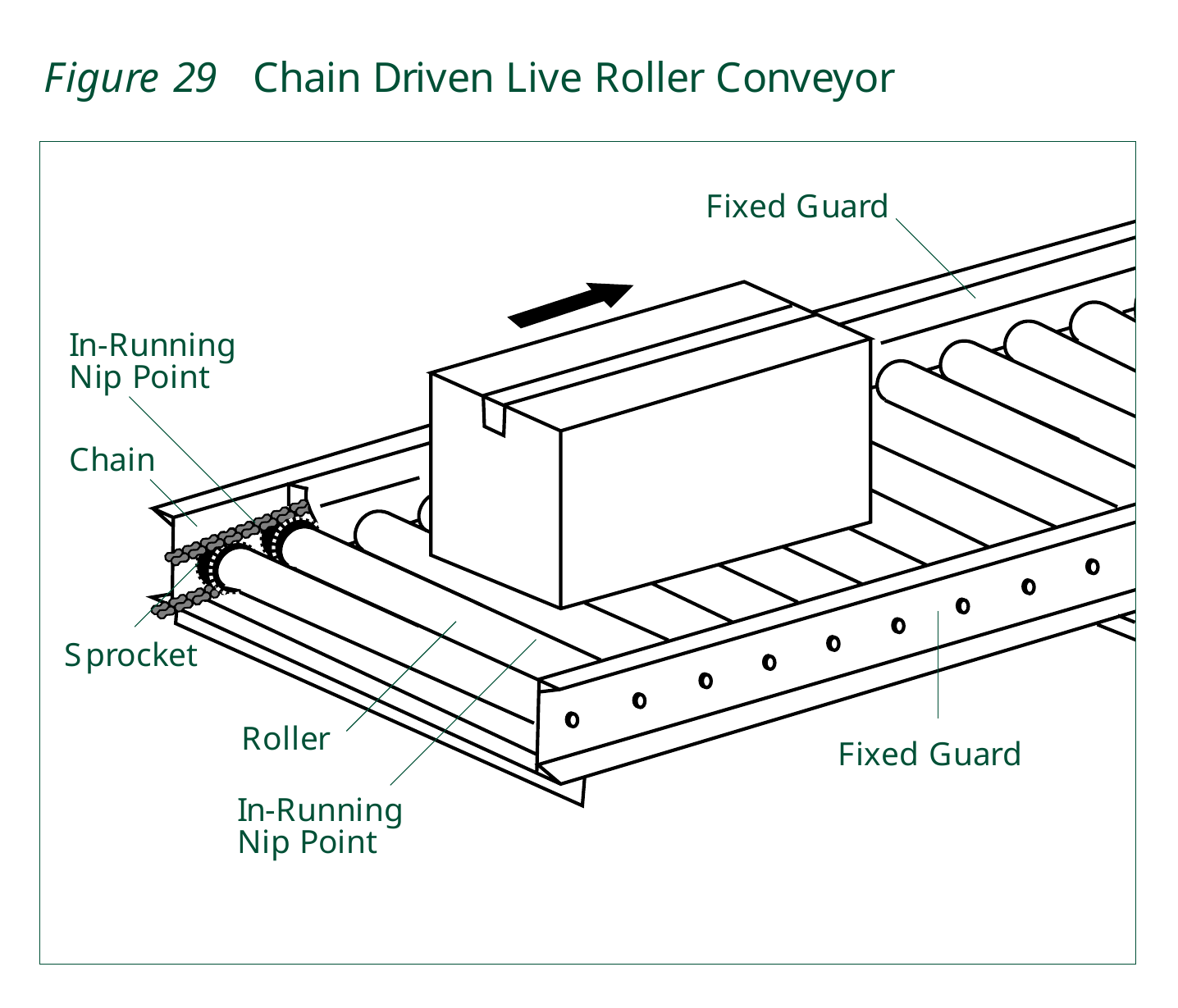
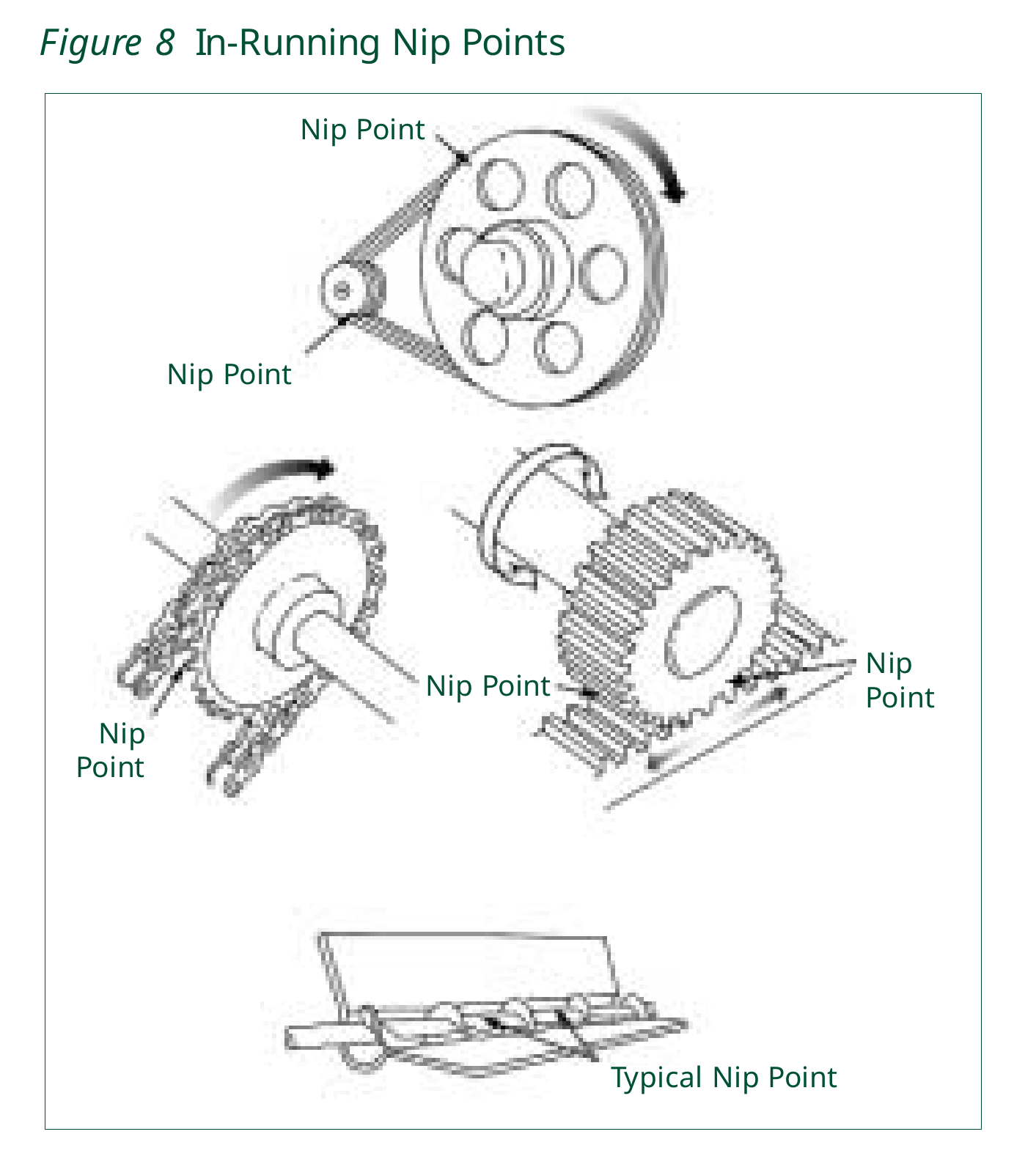
A guard at the conveyor roller — a fixed barrier that keeps hands, gloves, and clothing out of the in-running nip point where the roller turns. The employer reported to OSHA that the machine was not guarded.
Guarding is the primary control. If a conveyor is sticking and the work takes someone up to a roller, the machine must also be shut down, locked out, and checked so it cannot start before a hand or glove goes near the nip point.
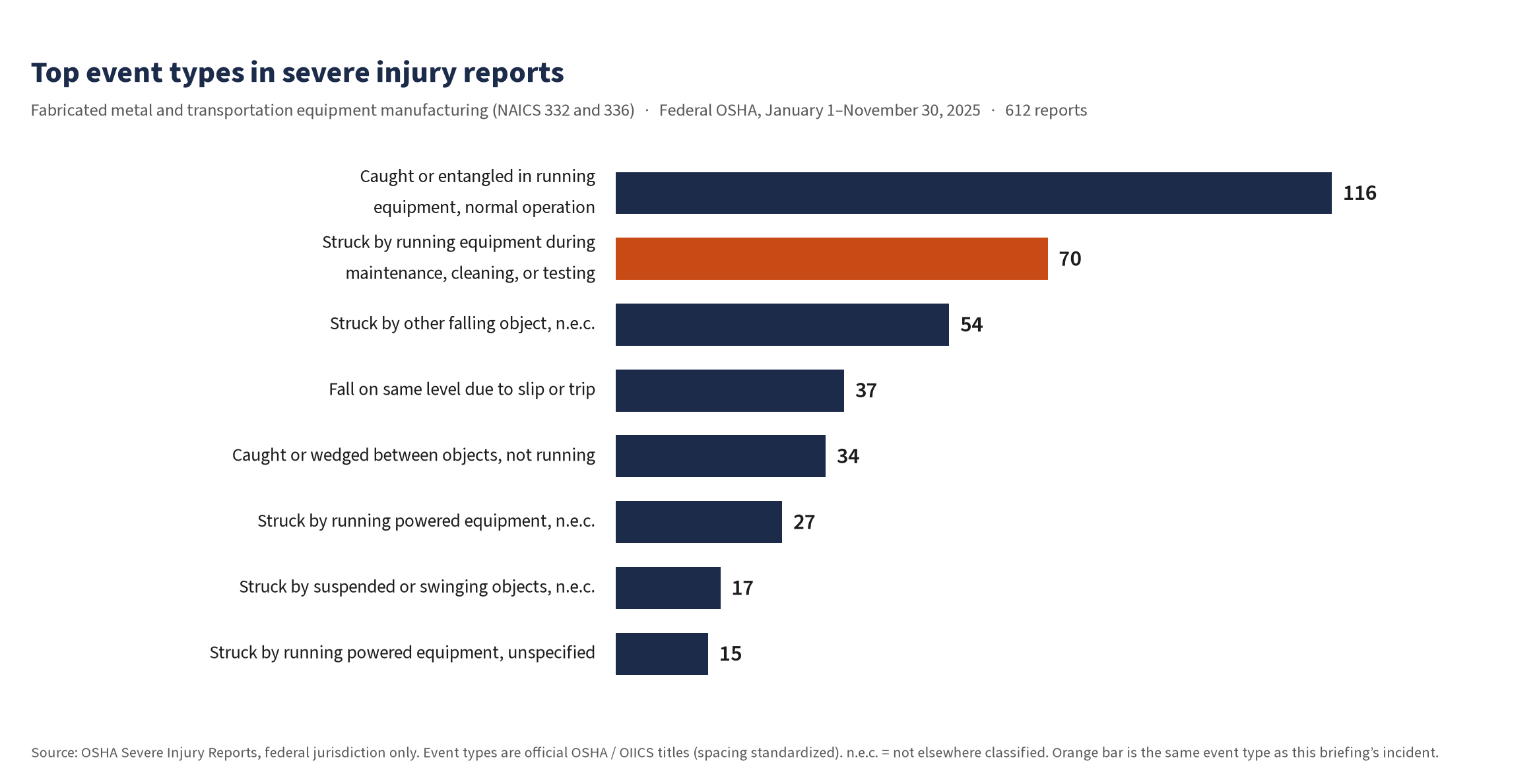
From January 1 through November 30, 2025, federal OSHA recorded 612 severe injuries in fabricated metal and transportation equipment manufacturing (NAICS 332 and 336). Two hundred seventy-six of those reports involved an amputation. Seventy reports — the same event type as this incident — were contact with running powered equipment during maintenance, cleaning, or testing.
Checks for this shift
- Before you start, walk the conveyors you will run or service. If a roller, pulley, belt, chain, or sprocket nip point is open, do not operate or troubleshoot it. Report it and get the guard back in place.
- If a conveyor is sticking, do not reach in. Do not use a glove, rag, or tool to free it while the conveyor can still move. Shut it down, lock and tag it, and verify it will not start before you put a hand near a roller.
- A glove can be pulled into a nip point, as the employer reported happened here. That is why the guard has to be in place during operation, and why lockout comes first when the work takes you to the roller.
- Confirm you know where the emergency stop is on each conveyor you will work this shift, and that you can reach it.
Discussion questions
- On the conveyors you will run or service this shift, where is a roller, pulley, belt, or chain nip point that is unguarded or easy to reach?
- If a conveyor sticks this shift, what is the exact sequence we use before anyone puts a hand, glove, or tool near a roller?
Supervisor sign-off
I briefed this crew on the incident, the control, the checks for this shift, and the discussion above.
This briefing does not replace training required by specific OSHA standards.
Supervisor name: ______________________________ Date: ______________ Shift: ______________
Crew count: ______________ Signature: ________________________________
Source reference
Incident: OSHA Severe Injury Report ID 2025021208 (UPA 2260048), event date February 6, 2025, Alabama, NAICS 336390 (Other Motor Vehicle Parts Manufacturing), inspection number 1803867. OSHA event title: Struck by running powered equipment during maintenance, cleaning, testing. Injury source: conveyors, unspecified. Secondary source, as coded by OSHA: gloves, handguards (except disposable, electric insulating). Employer name is withheld in this briefing.
Source URLs:
- OSHA Severe Injury Reports: https://www.osha.gov/severe-injury-reports
- Inspection lookup: https://www.osha.gov/ords/imis/establishment.inspection_detail?id=1803867
Industry counts and chart: OSHA Severe Injury Reports, federal OSHA jurisdiction only, January 1–November 30, 2025, NAICS 332 (fabricated metal product manufacturing) and 336 (transportation equipment manufacturing), 612 reports (400 in NAICS 332; 212 in NAICS 336). Dataset file: January2015toNovember2025, covering January 1, 2015 through November 30, 2025. These data do not include injuries in OSHA State Plan states and do not include work-related fatalities.
Built from the OSHA public record. Review with your site's competent person before use. This briefing does not replace training required by specific OSHA standards.